Black Checklink Wheel Nut Indicator and Retainer (32mm)
SKUCLBLK32
No reviews
Sale
Original price
£0.90
-Original price
£0.90
Original price
£0.90
£0.90
£0.90-£0.90
Current price
£0.90
| /
Exc. VAT
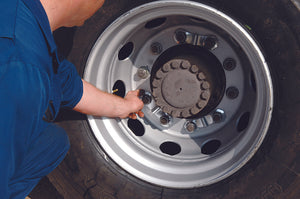
The Checklink® is a dual-purpose wheel nut indicator and retainer designed to provide clear visual guidance of wheel nut movement while offering a retaining function between adjacent nuts. Installed across two neighbouring wheel nuts, its distinctive ‘S’ shape helps create resistance to loosening caused by vibration.
Manufactured from high-grade virgin polymer, Checklink® not only indicates nut movement through distortion of its shape but also provides overheating indication by melting at a specific temperature. This allows early identification of potential issues such as brake or bearing faults, supporting safer vehicle operation and more effective fleet inspections.
Key Features
Dual-purpose design – acts as both a visual movement indicator and a retaining device between adjacent wheel nuts.
Movement indication – distortion of the ‘S’ shape clearly highlights nut movement.
Retaining function – specialist polymer link creates resistance to loosening caused by heavy vibration.
Overheating indication – melting provides a visible warning of excessive wheel temperatures from possible brake or bearing faults.
Supports fleet safety checks – enables faster and more efficient walkaround inspections.
Cost-effective solution – simple to install and easy to implement across fleets.
Professional safety commitment – demonstrates clear focus on roadworthiness and compliance to organisations including DfT, FORS, DVSA, HSE, FTA and RHA.
Specifications
Material – High-grade virgin polymer
Melt Temperature (Standard Version) – 125ºC / 257ºF
Melt Temperature (HT Version) – 165ºC / 329ºF
Application – Commercial vehicles including buses, trucks, agricultural vehicles, dangerous goods transporters, and other safety-critical applications subject to heavy vibration
Available Nut Sizes – 32mm
Checklink® provides visual guidance and a retaining function but does not guarantee that wheel nuts cannot loosen. Regular torque checks and maintenance procedures should always be followed.