




Why Do HGV Wheel Nuts Come Loose?
Wheel nut loosening is one of the most serious safety risks affecting heavy goods vehicles. If left unnoticed, it can lead to wheel damage, vehicle downtime, roadside prohibitions, or in the worst cases, complete wheel detachment.
For many years, wheel loss incidents were sometimes described as unpredictable or unavoidable. However, research and guidance from the DVSA, including its well-known publication Careless Torque Costs Lives, has made it clear that wheel loss is rarely random. In most cases, it happens because clamping force between the wheel and the hub has been reduced.
Understanding why this happens is the key to preventing it.
The Science Behind Wheel Security
Wheels are secured to the hub using studs and nuts. When a wheel nut is tightened, it stretches the stud slightly and creates tension. This tension produces what is known as clamping force, which presses the wheel firmly against the hub.
Clamping force is what actually holds the wheel in place. If that force is reduced for any reason, the wheel can begin to move slightly against the hub. Even tiny movements can gradually loosen the fixings until the wheel eventually detaches.
This is why correct installation and maintenance procedures are so important. Wheel nuts that are either too loose or too tight can both lead to problems.
Torque vs Clamping Force
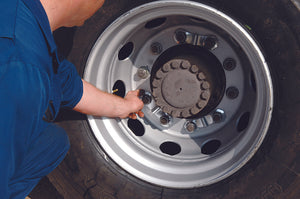
When installing wheel nuts, technicians apply torque using a torque wrench or torque gun. Torque is the rotational force used to tighten the nut.
However, torque is only the method used to achieve the real objective: creating sufficient clamping force.
You can think of torque as the input, and clamping force as the result.
Several factors influence how much clamping force is actually produced, including friction, lubrication, surface condition and component quality. Because of this, the torque reading alone does not always guarantee that the correct clamping force has been achieved.
This is why manufacturers specify torque settings and tightening sequences, and why wheels must be re-torqued after installation.
Common Reasons HGV Wheel Nuts Come Loose
There are a number of factors that can reduce clamping force over time. In most cases, wheel nut loosening is linked to one or more of the following issues.
Incorrect Torque
If wheel nuts are not tightened to the manufacturer’s specified torque, the clamping force may be insufficient to hold the wheel securely.
Under-torquing can allow movement almost immediately, while over-torquing can stretch wheel studs beyond their elastic limit. This can weaken the stud, damage threads, or even lead to stud failure.
Improper Tightening Procedure
Wheel nuts should always be tightened using the correct sequence, usually a star or criss-cross pattern. This ensures the wheel seats evenly against the hub.
If nuts are tightened unevenly or out of sequence, some studs may carry more load than others, increasing the likelihood of loosening.
Joint Settling After Installation
After a wheel has been fitted and torqued, the mating surfaces between the wheel and hub may settle slightly during initial use.
This settling can reduce the clamping force created during installation. For this reason, wheels should be re-torqued after the vehicle has travelled around 50-100 km / 30-65 miles following a wheel change.
Dirt, Rust or Contamination
Debris between the wheel and hub surfaces can prevent the wheel from sitting flush during installation.
As the vehicle moves, this material can compress or break down, reducing the clamping force and allowing the nuts to loosen.
Paint or Coatings
Paint on wheel mounting surfaces can cause similar problems. Under heat from braking, paint can soften or compress, which reduces the clamping force applied during installation.
Once the clamping force drops, vibration can gradually loosen the fixings.
Thermal Expansion and Contraction
HGV wheels experience repeated heating and cooling cycles caused by braking and road conditions.
As studs and components expand and contract, small changes in tension can occur, which may contribute to gradual torque loss.
Vibration and Heavy Loads
Commercial vehicles operate under demanding conditions. Heavy loads, uneven road surfaces, potholes and long-distance travel all generate vibration and dynamic forces.
If the clamping force is not sufficient, these forces can gradually work wheel nuts loose.
Component Wear or Poor Quality Fixings
Wheel studs, nuts and hubs must be in good condition and of the correct specification.
Worn threads, corrosion or damaged components can prevent correct torque from being applied and may lead to premature loosening.
Why Wheel Loss Is So Dangerous
A detached HGV wheel can weigh around 85kg and can continue travelling at high speed after leaving the vehicle. When a wheel bounces or strikes another vehicle, the impact force can be enormous.
There have been numerous incidents where loose lorry wheels have caused serious damage or fatalities on UK roads. Even where injuries are avoided, the consequences for operators can be severe.
Following a wheel-off incident, authorities will typically conduct a detailed investigation into vehicle maintenance procedures. Failures in inspection routines, installation procedures or maintenance records can lead to prosecutions, fixed penalties, or in serious cases the suspension or revocation of an operator’s licence.
The Importance of Regular Wheel Checks
Because wheel nuts can gradually lose tension, regular inspections are essential.
Drivers should check wheel fixings during daily walkaround inspections, looking for signs of movement, damage or loose components. However, identifying early movement can be difficult without visual reference points.
This is why many fleets fit wheel nut indicators. These devices provide a clear visual guide during inspections and help drivers quickly identify if a wheel nut has begun to move.
Another option is wheel nut locks, which go beyond acting as a visual indicator, but physically stops the wheel nuts from coming loose by being fit across 2 adjacent wheel nuts.

Preventing Wheel Nut Loosening
While no mechanical system is completely immune to loosening, most wheel loss incidents can be prevented through proper maintenance and inspection procedures.
Key preventative measures include:
- Using calibrated torque wrenches set to the manufacturer’s specification
- Following the correct tightening sequence when installing wheels
- Ensuring wheel and hub surfaces are clean and undamaged
- Re-torquing wheels after the recommended running distance
- Inspecting wheel fixings during daily vehicle checks
- Using visual aids to help detect early wheel nut movement
- Using wheel nut locks to keep wheel nuts in place even when clamping force is lost.
When these practices are followed consistently, the risk of wheel loss can be dramatically reduced.
Final Thoughts
Wheel nuts rarely loosen without a reason. In almost every case, the root cause is a loss of clamping force caused by incorrect installation, component condition, or operating conditions.
By understanding the mechanics behind wheel security and implementing proper inspection routines, fleets and drivers can greatly reduce the risk of wheel-off incidents and improve overall road safety.
